

Your revenue is up. You have more clients than this time last year. The team has grown.
And yet something feels wrong.
Your phone does not stop. Decisions wait for you. Quality dips when you travel. You hired more people and somehow created more problems. You are busier than ever, and the business feels harder to hold together, not easier.
This is not a motivation problem. It is not a management style problem. It is a structural problem with a specific name.
The Gap Between Revenue and Capability
Revenue measures what a business earns. Capability measures what a business can consistently do without depending on any single person.
These two things are not the same, and in Nigerian SMEs they routinely diverge.
A business can grow to ₦200M in annual revenue and still be structurally immature: still running on the founder's memory, still collapsing when key people are unavailable, still unable to produce a reliable forecast or delegate a decision with confidence. The money is real. The structure is not there yet.
This is the gap most growth-stage founders hit between years three and seven: the business that was held together by hustle, talent, and sheer personal force reaches a size where those things stop being sufficient. The founder is no longer the solution. The founder has become the bottleneck.
Revenue measures what a business earns. Capability measures what it can consistently do without depending on any single person. Growing businesses regularly have one without the other.
Three Scenarios That May Look Familiar
Scenario one: The phone that never stops ringing.
A business owner in Abuja runs a facilities management firm with 45 staff. Revenue crossed ₦150M last year. But every vendor issue, every client complaint, every staff dispute routes to her. She has not taken a full day off in three years. She is not micromanaging. She genuinely cannot find anyone who knows enough to handle these things independently. The knowledge lives in her head, not in the business.
Scenario two: Quality that drops when the owner travels.
A logistics company in Lagos grows 40% in eighteen months. The founder hires a manager and takes his first international trip. He returns to three client escalations, two missed deliveries, and a staff conflict that no one resolved. The manager did not fail. There was simply no documented process, no decision authority, no standard to uphold. There was only the founder's personal standard, which no one else could access.
Scenario three: More people, more complexity.
A consulting firm doubles its headcount from eight to sixteen. Revenue does not double. In fact, for three quarters it barely moves. New hires are underutilised. Senior staff spend time supervising instead of delivering. Meetings multiply. The founder assumed that adding people would add capacity. Instead, it added coordination cost, because the operations structure was never built to support a team larger than eight.
“The founder is no longer the solution. The founder has become the bottleneck.”
What Structure Actually Means
When MRT refers to structure, it does not mean process for its own sake. It means the eight foundational systems that allow a business to operate, grow, and adapt without depending on any single person's availability or memory.
These are the 8 Core Structures, the framework MRT has developed over fifteen years of working with Nigerian businesses across industries:
- Strategic Structure — your direction, goals, and decision filters
- Financial Structure — your numbers, forecasts, and capital discipline
- Operations Structure — your documented processes and quality standards
- Marketing & Sales Structure — your pipeline, conversion process, and client retention system
- Human Resources Structure — your hiring framework, performance standards, and team development
- Legal & Compliance Structure — your contracts, CAC standing, FIRS compliance, and regulatory posture
- Data Structure — your metrics, reporting, and decision-making infrastructure
- Technology Structure — the digital tools and systems that support the above seven
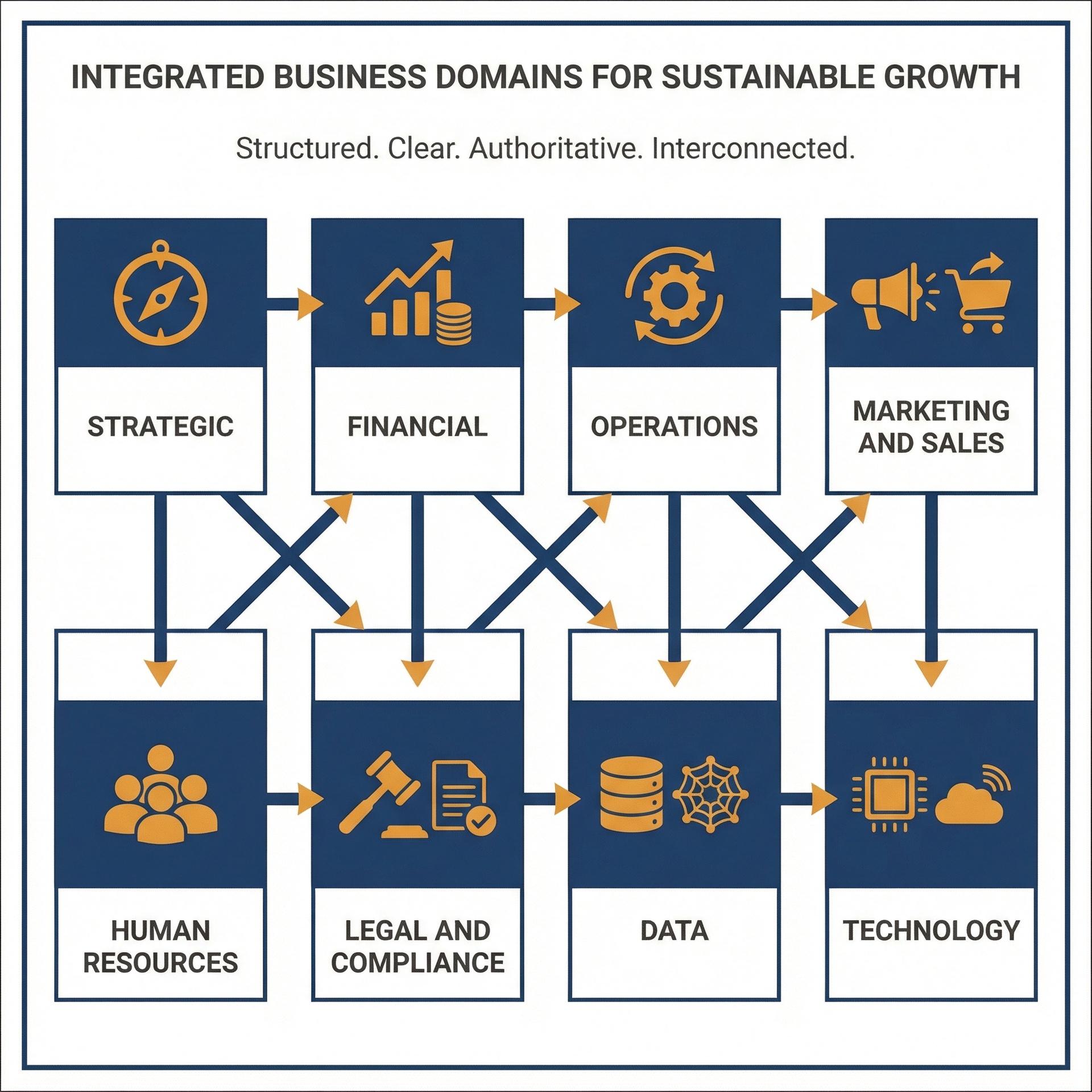
Most businesses entering the growth stage have one or two of these structures in reasonable shape, typically the one closest to the founder's professional background. A finance director who started a business usually has reasonable Financial Structure. A marketing professional who built a firm usually has decent Marketing & Sales Structure.
The remaining six exist informally, if at all. And at small scale, that is manageable. At ₦100M revenue and twenty staff, it is not.
Why the Chaos Intensifies as You Grow
This is the counterintuitive reality that catches most growth-stage founders off guard: growth without structure does not reduce chaos. It amplifies it.
When your business was smaller, you could hold the missing structures in your head. You knew every client. You remembered every process. You caught every mistake personally. Scale breaks all of that. The same structural gaps that were manageable at ₦30M become acute at ₦150M, because the volume is higher, the team is larger, the client expectations are greater, and the consequences of failure are more significant.
This is not a criticism of how founders build companies. It is the natural trajectory of an owner-led business that has outgrown its founding infrastructure.
The question is not whether you have structural gaps. Every Nigerian SME does. The question is which gaps are creating the most friction right now, and which ones will become critical next.
Measuring the Gap: The Business Capability Index
Structural gaps can be diagnosed, scored, and prioritised.
The Business Capability Index (BCI) is MRT's diagnostic framework for measuring business capability across all eight structures. It produces a score in the format Performance.Structure.Stage, each component rated on a 0–100 scale.
A business scoring 61.32.2, for example, is performing reasonably well (61) but is structurally immature (32) for a company at its revenue stage (Stage 2). The performance score reflects what the business currently earns and delivers. The structure score reflects the capability infrastructure underneath it. The gap between those two numbers is where the chaos lives.
When founders complete the BCI Assessment, the output is not a ranking or a certificate. It is a diagnostic map: a scored breakdown of which of the eight structures are in reasonable shape and which are creating structural drag. It identifies where the investment should go first.
The Work That Makes Growth Sustainable
The businesses that grow past ₦500M without falling apart are not the ones with the most talented founders. They are the ones that systematically built their eight structures while they were growing, not after things broke.
That work is not glamorous. Documenting processes is not exciting. Building a pricing framework is not the same as closing a deal. Defining a performance management system is harder and slower than hiring by feel.
But it is the work that converts hustle-built revenue into durable capability. It is the difference between a business that depends on you and a business that belongs to you.
- Revenue growth and structural maturity are not the same thing. A business can earn more while becoming harder to manage, because the underlying capability infrastructure was never built.
- The chaos a growing founder feels is not a sign that they are failing. It is a predictable signal that the business has outgrown its founding structure and needs its eight foundational systems built or strengthened.
- Structural gaps can be diagnosed and prioritised. The BCI Assessment maps all eight structures, identifies which are creating the most drag, and tells you where to build first.
Where to Start
If what you have read describes your business, or the direction it is heading, the most useful next step is not another management book. It is a diagnostic.
The free BCI Assessment takes 30–45 minutes and produces a scored breakdown of all eight of your structures. It tells you exactly which gaps are largest, and gives you a clear starting point for the work.
Take the BCI Assessment: bci.mrtnetsolutions.com/micro-bci
MRT Net Solutions Ltd has worked with Nigerian businesses since 2008. The 8 Core Structures framework is the foundation of every engagement — from a single advisory session to a full transformation programme.