

Most Nigerian SME founders have one or two structures in genuinely good shape. Usually whichever structure maps closest to the founder's professional background before they started the business.
The accountant who built a trading company tends to have solid Financial Structure. The engineer who started a construction firm usually has disciplined Operations Structure. The marketing professional who launched an agency almost always has strong Marketing & Sales Structure.
The remaining six structures exist informally, if at all. At five staff and ₦30M revenue, that is survivable. At twenty-five staff and ₦250M, it is the primary source of operational chaos, founder burnout, and growth that stalls exactly when it should be accelerating.
This article is a reference piece. It walks through each of the 8 Core Structures in turn: what it is, what it contains, what its absence costs, and what "functional" looks like. Not perfection. Functional.
The 8 Core Structures: An Overview
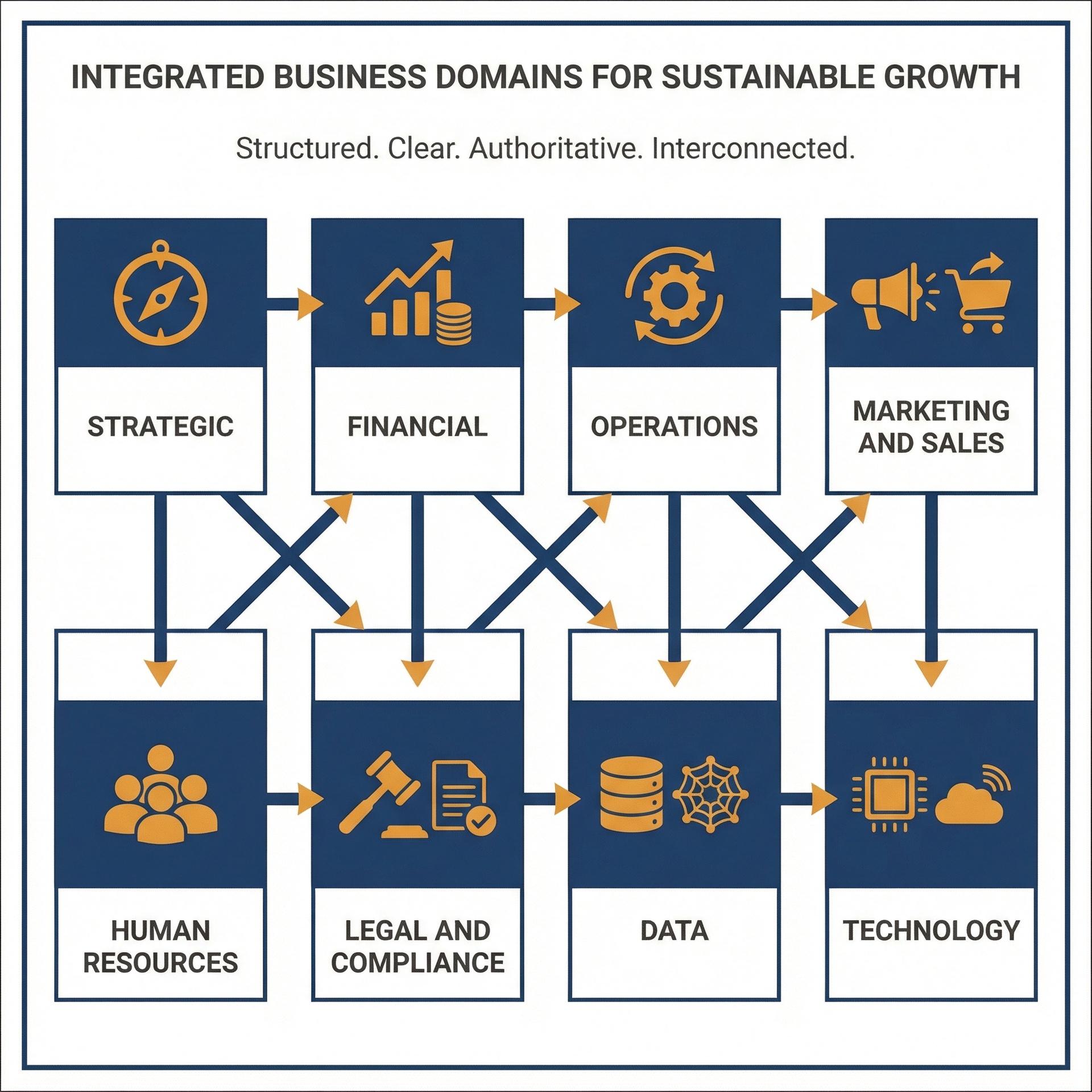
The 8 Core Structures are the foundational systems every growth-stage business needs to operate, grow, and adapt without depending entirely on any one person's availability or memory. They are: Strategic, Financial, Operations, Marketing & Sales, Human Resources, Legal & Compliance, Data, and Technology.
These are not departments. Not every business needs eight departments. But every business operating at meaningful scale needs these eight systems, because without them, growth creates chaos faster than it creates capability.
The Business Capability Index (BCI) measures business capability across all eight in the format Performance.Structure.Stage, each component on a 0–100 scale. A business that scores 58.29.2 is performing at 58, structurally at 29, and is at Stage 2 of its growth cycle. The gap between performance and structure is where the operational pain lives.
The 8 Core Structures are not a maturity model where you graduate from one to the next. They are interdependent. A gap in one creates drag on all the others. A business with strong Financial Structure but weak Operations Structure will eventually have its financial performance eroded by operational inconsistency.
1. Strategic Structure
What it is: The system that defines where the business is going, how it will get there, and how decisions are made when the path is unclear.
What it contains: A documented business direction (not a vision statement on the wall, but an actual written strategy), annual and quarterly goals with owners and metrics, a clear definition of who the business serves and who it does not, a framework for evaluating new opportunities versus distractions, and a regular rhythm for reviewing performance against plan.
What its absence costs: Without Strategic Structure, the business responds to whatever is loudest. Every opportunity looks viable. Every client request gets a yes. The founder spends the year busy and productive and, at the end of it, no closer to the business they intended to build. In Nigerian market conditions, where informal opportunities appear constantly, the absence of strategic filters is particularly expensive.
What functional looks like: A written one-page strategy reviewed quarterly. Annual revenue and margin targets by service line, with owners named. A written "we do not do" list, the filter that protects the business from scope creep and wrong-fit clients. A monthly leadership check-in against plan. That is all. Strategic Structure does not require a fifty-page strategy document. It requires documented decisions, not aspirational thinking.
2. Financial Structure
What it is: The infrastructure that makes money legible: not just how much comes in, but where it goes, when it arrives, what it costs to generate, and whether the business can survive its own growth.
What it contains: Disciplined bookkeeping (not just year-end accounts for FIRS filing), a rolling cash flow forecast of at least 90 days, a pricing framework that calculates actual cost-to-serve rather than guessing at margins, a budget that is reviewed against actuals monthly, and a basic understanding of the difference between revenue, gross profit, and net profit.
What its absence costs: The contractor who invoices ₦8M in a month and cannot make payroll is not unusual in Lagos or Abuja. Sixty-day payment terms, untracked expenses, and the habit of treating bank balance as profit are the predictable consequence of missing Financial Structure. A business can be growing and insolvent simultaneously. Many Nigerian SMEs are.
What functional looks like: Books that are updated weekly, not once a year before the accountant files. A 90-day cash flow model, even a basic spreadsheet, that shows projected inflows and outflows by week. A pricing structure that accounts for direct costs, overhead, and target margin before quoting. A monthly P&L review where the founder actually reads the numbers, not just the bank balance. Financial Structure is not about sophistication. It is about discipline.
3. Operations Structure
What it is: The system that ensures work is done consistently, to a defined standard, by defined people, through a defined process, regardless of who is available on a given day.
What it contains: Documented Standard Operating Procedures (SOPs) for the five most frequently repeated processes in the business, clear assignment of decision authority for routine operational matters, a quality standard that does not depend on the owner's physical presence, a system for tracking work in progress and flagging exceptions, and an onboarding process that gets a new hire to minimum competence in weeks rather than months of shadowing.
What its absence costs: The business that collapses when the key person is unavailable. The client escalation that nobody resolved because nobody knew what "resolving it" looked like. The quality variance between what happens when the founder is watching and what happens when they are not. In service businesses such as consulting, logistics, and facilities management, Operations Structure is the difference between a business and a boutique that only works at small scale.
What functional looks like: Five documented SOPs. Not novels, not flowcharts with thirty boxes, just written descriptions of the process, who does each step, what good looks like, and what to do when something goes wrong. A decision log that captures who can approve what, up to what value. A weekly operational review meeting with a standing agenda. A checklist-based handover process when staff change roles.
4. Marketing & Sales Structure
What it is: The operational infrastructure that makes revenue generation predictable, transferable, and not entirely dependent on the founder's personal relationships.
What it contains: A written definition of the ideal client (sector, size, decision-maker profile, typical problem, typical budget), a lead qualification process, defined pipeline stages with clear criteria for progression, a documented sales cadence, a CRM system where all active opportunities are recorded and visible to more than one person, and a client retention process.
What its absence costs: Revenue that tracks the founder's personal energy and availability, not the market's demand. A sales team that produces inconsistent results because they have no process to operate within. The inability to forecast revenue for the next quarter, which makes hiring decisions, lease decisions, and bank conversations all harder than they need to be.
What functional looks like: A two-page customer definition document. A qualification checklist of five to eight criteria that determine whether to pursue an opportunity. A CRM, even a maintained spreadsheet, where every active opportunity has a stage, a next action, and a next-action date. A monthly pipeline review where the founder is reviewing the system, not carrying the system personally.
“When the founder is the pipeline, the business has no Marketing & Sales Structure. It has a person.”
5. Human Resources Structure
What it is: The system that makes people management consistent, fair, and capable of scaling beyond the founder's personal relationships with each staff member.
What it contains: Written job descriptions for every role, a structured hiring process that goes beyond referrals and gut feel, a performance management framework with defined standards and regular review cycles, a compensation framework that is internally consistent and externally competitive, a disciplinary and grievance process, and compliance with Nigerian labour law obligations, including NSITF contributions, pension remittances, and basic employment contracts.
What its absence costs: High turnover driven not by pay but by lack of clarity, fairness, and development. The founder who manages each person differently according to personal relationship, which eventually creates a perception of favouritism that erodes team cohesion. The legal exposure from undocumented employment relationships, which Nigerian courts have increasingly treated as binding regardless of informal agreement. A team of individually capable people who do not compound.
What functional looks like: A job description for every current role, even a one-page version. A three-stage hiring process: written criteria, structured interview, reference check. Monthly one-on-ones between managers and direct reports, documented in a shared system. Quarterly performance conversations against written goals. NSITF and pension compliance current. A staff handbook that exists and is given to new hires.
6. Legal & Compliance Structure
What it is: The infrastructure that protects the business from legal and regulatory exposure, not just at formation, but continuously, as the business evolves and takes on more obligations.
What it contains: Current CAC registration and updated filing status, FIRS tax compliance (company income tax, VAT, PAYE for staff), standard contracts for clients, suppliers, and staff that have been reviewed by a qualified lawyer, SCUML registration if the business operates in a regulated sector, data handling practices that comply with NDPR, and an annual legal health check.
What its absence costs: The service agreement dispute where the client claims the terms were never agreed in writing. And they are correct, because there was no written contract. The FIRS audit that reveals three years of unfiled returns. The business that cannot complete a government procurement process because its CAC status has lapsed. Legal gaps are inexpensive to fill and expensive to discover late.
What functional looks like: A template client contract reviewed by a lawyer, used consistently. Current FIRS registration and up-to-date filing. A staff contract issued to every employee on their first day. A simple NDPR-compliant privacy notice on the website if personal data is collected. An annual conversation with a corporate lawyer, not just at formation, but every year.
7. Data Structure
What it is: The system that ensures the right numbers are tracked, reported, and used to make decisions, rather than relying on the founder's intuition or end-of-year accounts.
What it contains: A defined set of Key Performance Indicators (KPIs) for each major function in the business, a reporting rhythm that produces those numbers weekly or monthly, a single source of truth for business performance that any key stakeholder can access, a data retention and storage policy, and basic business intelligence that tracks trends rather than just snapshots.
What its absence costs: Decisions made on feel rather than evidence. The hiring decision made because "we're busy" rather than because utilisation data showed a genuine capacity gap. The service line kept alive because the founder likes it, rather than cut because margin data showed it was cross-subsidised by other work. In a business without Data Structure, management is memory-based, which is both exhausting and inaccurate.
What functional looks like: A dashboard, even a shared spreadsheet updated weekly, that shows revenue, cash, pipeline value, and one operational metric per function. A monthly report reviewed by the leadership team. A definition of what each metric means and who owns keeping it current. That is sufficient for most businesses at Stage 2. The goal is not a data warehouse. The goal is decisions made on evidence rather than instinct.
8. Technology Structure
What it is: The system that ensures digital tools are selected, implemented, and used in a way that supports the other seven structures, rather than adding cost and complexity without corresponding capability.
What it contains: A technology map of what tools the business uses and what purpose each serves, a policy for data storage and access management, integration between key systems (particularly between CRM, finance, and operations tools), a basic cybersecurity posture, and a process for evaluating and adopting new technology against actual business need rather than novelty.
What its absence costs: Subscription costs for tools nobody uses. Three different WhatsApp groups serving the same coordination function. Client data stored across personal Gmail accounts, WhatsApp chats, and the founder's desktop. A business that has spent ₦2M on software and is still running on spreadsheets and memory because implementation was never completed.
What functional looks like: A written list of every active software subscription, what it costs, and what it does. A single system of record for client data that is not a personal device. Basic password management, with shared credentials managed through a team tool rather than a sticky note. A six-month technology review to assess whether current tools are serving current needs. Technology Structure is not about having the latest tools. It is about using the right tools deliberately.
The Honest Reality
Most Nigerian SMEs, including good, growing, profitable ones, have two or three of these structures in functional shape. The rest exist as the founder's intention, a half-finished process, or not at all. That is not a character flaw. It is the natural condition of a business that was built through effort and instinct and has not yet had the time, resource, or framework to build the underlying infrastructure.
The BCI Assessment makes this visible. It scores each of the eight structures individually, which means a business can see exactly where the strength is and where the gap is, rather than operating on a general sense that "things could be better." A business that scores 72 on Financial Structure and 18 on HR Structure has a very different priority list than one scoring the reverse.
- The 8 Core Structures (Strategic, Financial, Operations, Marketing & Sales, Human Resources, Legal & Compliance, Data, and Technology) are the foundational systems every growth-stage SME needs. Most Nigerian businesses have two or three in functional shape. The rest exist informally or not at all.
- Each structure has a specific cost when absent: revenue unpredictability, operational collapse when key people are unavailable, legal exposure, decisions made on feel rather than data. The costs are concrete and compound as the business grows.
- "Functional" does not mean perfection. It means the structure exists, is documented, operates independently of any single person, and can be handed to someone new. That baseline is achievable for every SME. The gap is usually clarity and prioritisation, not resources.
Using This as a Diagnostic Starting Point
Read back through the eight sections above. For each one, ask a simple question: if you took yourself out of the picture for four weeks, would this structure function? Not perfectly, but function?
The structures where the answer is yes are your current strengths. The structures where the answer is no, or where you cannot even answer clearly because nothing is written down, are your structural debt.
The BCI Assessment takes 30–45 minutes and gives you a scored breakdown of all eight structures. It tells you which gaps are largest, which are most urgent given your growth stage, and where to start the work.
https://www.mrtnetsolutions.com/r/bjs
MRT Net Solutions Ltd has worked with Nigerian businesses since 2008. The 8 Core Structures framework is the foundation of every engagement — from a single advisory session to a full transformation programme.